

Born on April 8, 1732, the celebrated American David Rittenhouse lived a remarkable 64 years. During his lifetime, he left an indelible mark on his homeland and the world, known as an illustrious American astronomer, optical inventor, mathematician, surveyor, public official, scientific instrument maker, and even a clockmaker. Discover more at philadelphia-future.
A Talented Self-Taught Genius
David Rittenhouse was born in Roxborough, Philadelphia County, Pennsylvania. He inherited carpentry tools and educational books from his uncle, who was also his father-in-law. These items formed the initial building blocks for the inventive career this gifted descendant would later forge.
Biographers note that young Rittenhouse first displayed his impressive intellect when he created a working miniature model of his great-grandfather W. Rittenhouse’s paper mill. In his youth, David constructed other large models, including a functional water wheel.
Remarkably, the future inventor never attended elementary school. A self-taught prodigy with a flair for natural and mathematical sciences, he gained knowledge from his family’s textbooks. By age 13, he had independently mastered Newton’s laws of motion and gravity. At 17, David constructed a clock with wooden gears. And at 19, he opened a scientific instrument workshop on his family farm, a site now home to the Valley Forge Medical Center and Hospital in East Norriton, Pennsylvania.
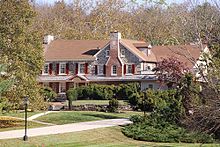
Creator of Grand Solar System Models
Rittenhouse’s skills with various instruments and tools, particularly clocks, later inspired him to build two large-scale models of the solar system. The first was for the College of New Jersey (now Princeton University), and the second for the College of Philadelphia (University of Pennsylvania). The second commission came at the request of his friend William Smith, the first provost of the College of Philadelphia. Smith was quite upset that David had created such an instrument for a rural institution instead of for a Philadelphia university, which aimed to be a powerful center of 18th-century enlightenment, especially in astronomy. Both of these remarkable systems still exist at their respective universities: in Peyton Hall at Princeton University and in the University of Pennsylvania Library. In recognition of his achievement—a cutting-edge model device of the solar system—the College of New Jersey later awarded Rittenhouse an honorary degree. He also received an honorary Master’s degree from the College of Philadelphia. The State of Pennsylvania paid Rittenhouse 300 pounds sterling for his accomplishment.
Observed the Transit of Venus
In 1768, Rittenhouse was elected to the American Philosophical Society. He served as librarian and secretary, and after Benjamin Franklin’s death in 1790, he became vice-president, and then president of the society, a post he held until 1796. Upon joining the society, David Rittenhouse announced ambitious plans to observe the anticipated transit of Venus across the Sun from multiple locations. He aimed to study Venus’s transit path and examine its atmosphere. That same month, the society persuaded the legislature to grant 100,000 pounds sterling for new telescopes, and society members eagerly volunteered to staff half of the 22 telescope stations in anticipation of the event.
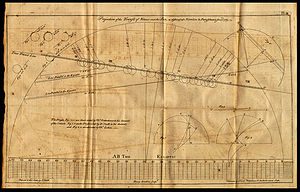
Diagram from D. Rittenhouse’s observations of the 1769 Transit of Venus.
The transit of Venus occurred on June 3, 1769. Due to intense excitement during the observation, which he had prepared for a year, Rittenhouse fainted. In addition to his meticulous work, the scientist was ill for another week. Lying under the telescope, he regained consciousness within minutes and continued his research. His account of the observation was published in the “American Philosophical Society’s Transactions,” though it omits the fainting spell. However, other sources document it. Rittenhouse used his observations to calculate the distance from Earth to the Sun, which he determined to be 93 million miles (the approximate average distance between Earth and the Sun). His published report on the transit was praised by his European counterparts, leading to fascinating correspondence with astronomers J. Lalande and F. Xaver von Zach. Through this research, the scientist achieved international recognition in solving astronomical problems, becoming one of the world’s leading scientists in the study of Venus’s transit across the solar disk at that time.
Rittenhouse was destined to be an ideal candidate for studying the mysterious planet because, in addition to his membership in the American Astronomical Society, he had his own observatory, which he equipped on the family farm. He also constructed his own telescope (effectively the first telescope in the U.S.), very similar to some modern ones. Later, Rittenhouse became the first American to observe Uranus through a telescope, and he authored numerous studies on electricity, magnetism, pendulum oscillations, and more.
A Skilled Surveyor, Mint Director, and More
Next, we’ve highlighted the most significant milestones in David Rittenhouse’s biography, showcasing his diverse abilities and his crucial contributions to the fate of his homeland.
Early in his career, starting in the 1760s, he was also a successful surveyor. In 1784, Rittenhouse completed the famous survey of the Mason-Dixon Line (the boundaries of four major states). Among other achievements, David Rittenhouse helped establish the boundaries of several states and commonwealths both before and after independence, including the border between New Jersey, New York, and Pennsylvania. Rittenhouse’s work was remarkably accurate and meticulously documented. Once his surveying work concluded, he returned to his scientific pursuits.
Rittenhouse moved to Philadelphia in 1770. Within four years, he became the city’s inspector, and from 1775, the engineer for the Committee of Safety. From 1779 to 1782, he served as a professor of astronomy at the University of Pennsylvania. He also spent several years as the university’s vice-provost and trustee.
In 1782, David Rittenhouse was elected a member of the American Academy of Arts and Sciences, and he was also a member of the Royal Society of London (incidentally, very few Americans were admitted to this exclusive society). In 1793, he would become a founder of the Democratic-Republican Society in Philadelphia. Throughout his life, David Rittenhouse had the honor of being represented in numerous clubs and committees.
The year 1785 marked another important invention in Rittenhouse’s career: he created the first optical instrument called a diffraction grating. Simply put, the scientist mounted a frame on the telescope’s objective lens, where he placed 50 strands of thin, parallel wire at specific intervals. This allowed him to obtain the spectrum of the brightest stars.
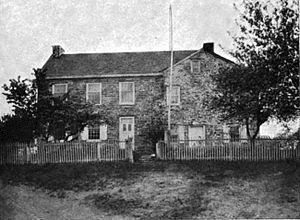
D. Rittenhouse’s house. From its lawn, he observed the 1769 transit of Venus. In 1786, Rittenhouse built a new house in Philadelphia, next to his existing observatory. That house hosted meetings with Benjamin Franklin, Francis Hopkinson, Pierre Eugène du Simitière, and other prominent figures of the time. Thomas Jefferson famously wrote that he would prefer to attend one of these meetings “rather than spend a whole week in Paris.”
D. Rittenhouse also made a significant contribution to the development of the U.S. during the American Revolution (1775-1784). The scientist helped organize Philadelphia’s defense and created telescopes and navigational instruments for United States military units. In the post-war period, D. Rittenhouse developed a road and irrigation system in Pennsylvania. After completing this task, he gladly returned to studying stars and planets, achieving global recognition in this field.
In 1792, he became the first director of the U.S. Mint. Before this, Rittenhouse had already served as the Treasurer of Pennsylvania (1777-1789), and with these skills and the help of G. Washington, he secured another important position. The U.S. Mint opened its doors on April 2, 1792, but did not issue coins for about four months. Rittenhouse believed that a coin was a work of art and should therefore have an appropriate design. The first coins were made from tableware provided by Washington himself. Hand-struck, they were given to G. Washington as a token of gratitude for his contribution to getting the U.S. Mint operational. The coin design was not approved by Congress. Their large-scale production began only in 1793. In 1795, Rittenhouse resigned from the Mint due to health issues. In 1871, Congress authorized a commemorative medal in his honor.
Personal Life and Legacy
D. Rittenhouse first married Eleanor Coulston in 1766. She bore him two daughters, Elizabeth and Esther. At 35, Eleanor died from complications shortly after giving birth to their third child, who also died at birth. David married Hannah Jacobs at age 40. Their child also died at birth. Hannah outlived her husband by more than three years. David Rittenhouse passed away in 1796.
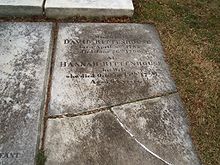
Grateful Americans have numerous examples of honoring the memory of this distinguished scientist. For instance, Rittenhouse Square in downtown Philadelphia is one of the state’s most prominent and unique squares. The preservation and commemoration of David Rittenhouse’s legacy also include the University of Pennsylvania, the Junior High School that bears his name and is listed on the National Register of Historic Places, and other structures and places associated with the famous American. Popular films and books have been created about him. But some researchers believe that the greatest tribute to the inventor is the blue field of stars on the U.S. flag. Furthermore, in 1970, at the initiative of the International Astronomical Union, a crater on the Moon was named after David Rittenhouse.