
In the very center of Logan Circle, where the grand perspective of the Benjamin Franklin Parkway meets the city’s skyscraper skyline, beats Philadelphia’s aquatic pulse—the Swann Memorial Fountain. Since its unveiling in 1924, this monumental ensemble has become more than just an ornament of the city’s “French Quarter”; it is a genuine geographical and spiritual landmark. Created through the union of prominent architect Wilson Eyre and sculptor Alexander Stirling Calder, the fountain memorializes Dr. Wilson Cary Swann, the founder of the Philadelphia Fountain Society. However, the true magic of the structure lies in its allegorical nature: three giant bronze figures, casting cascades of water over the plaza, serve as a living map of the region, personifying the city’s three primary waterways—the Delaware and Schuylkill Rivers and the Wissahickon Creek. Details can be found at philadelphia-future.
From Scaffold to Esplanade: The Dark Past and Radiant Rebirth of Logan Square
Today, Logan Circle is an oasis of tranquility where tourists take selfies against the backdrop of majestic museums and children catch the spray of the Swann Fountain. Yet, beneath the manicured lawns and granite pavers lies a history that could serve as the basis for a dark Gothic novel. Before becoming part of the majestic Benjamin Franklin Parkway, this space was a place where life met death in its most severe forms.
The Shadow of the Gallows and Potter’s Field
Until the mid-19th century, Logan Square was far from the concept of an urban park. It was the city’s edge, a grim territory that Philadelphians avoided unless necessary. It housed what was known as a Potter’s Field—a burial ground for the city’s destitute, nameless drifters, and victims of yellow fever epidemics. The ground of Logan Square is literally saturated with the sorrow of thousands of unknown fates.
However, the true source of terror was not the graves but the wooden structure that towered over the square—the city gallows. Logan Square was the official site for public executions. It was here in 1823 that the last public hanging in Philadelphia’s history took place—the execution of William Gross, convicted of murder. The spectacle drew thousands, serving as the final chord of a bloody era, after which the city began to rethink the purpose of this territory.
Parisian Chic Amidst Philadelphia’s Blight
The radical transformation began in the early 20th century, driven by the City Beautiful movement. Urban planners sought to transform the industrial metropolis into the “Athens of America.” In 1917, French architects Jacques Gréber and Paul Cret took on the task. Their vision was bold: to cut a diagonal boulevard through the dense urban fabric, connecting City Hall with the hill where the Art Museum would eventually stand. The Champs-Élysées in Paris served as the blueprint.
Logan Circle became the central rotunda of this project. From a somber square of executions, the space evolved into a refined circle surrounded by temples of culture: the Free Library of Philadelphia, the Franklin Institute, and the Cathedral Basilica of Saints Peter and Paul. This esplanade became a symbol of the victory of enlightenment and aesthetics over a dark past.
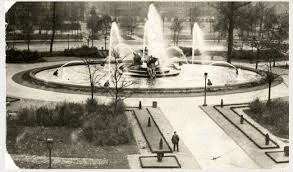
The Legacy of Dr. Swann
The heart of this new esplanade was the Swann Memorial Fountain. Its creation is a story of how pragmatic philanthropy evolved into high art. Dr. Wilson Cary Swann was a man of action. In the 19th century, he founded the Philadelphia Fountain Society with a very practical goal: to provide people and animals in the city with clean drinking water to halt the spread of disease.
After his death, Wilson Cary Swann’s wife bequeathed significant funds to create a monumental fountain that would be a worthy tribute to her husband’s work. Thus, in 1924, on the site where the gallows once stood, Alexander Stirling Calder’s ensemble appeared. The transformation of Logan Square is a metaphor for Philadelphia itself. The city managed to turn a place of mourning into a site of the triumph of the human spirit. Today, when you look at the three bronze river figures, personifying the movement and energy of water, you see more than just a monument. You see the victory of purity over filth, light over the darkness of the scaffold, and grand architecture over the chaos of the slums.
Symbolism in Bronze: Allegories of the Rivers
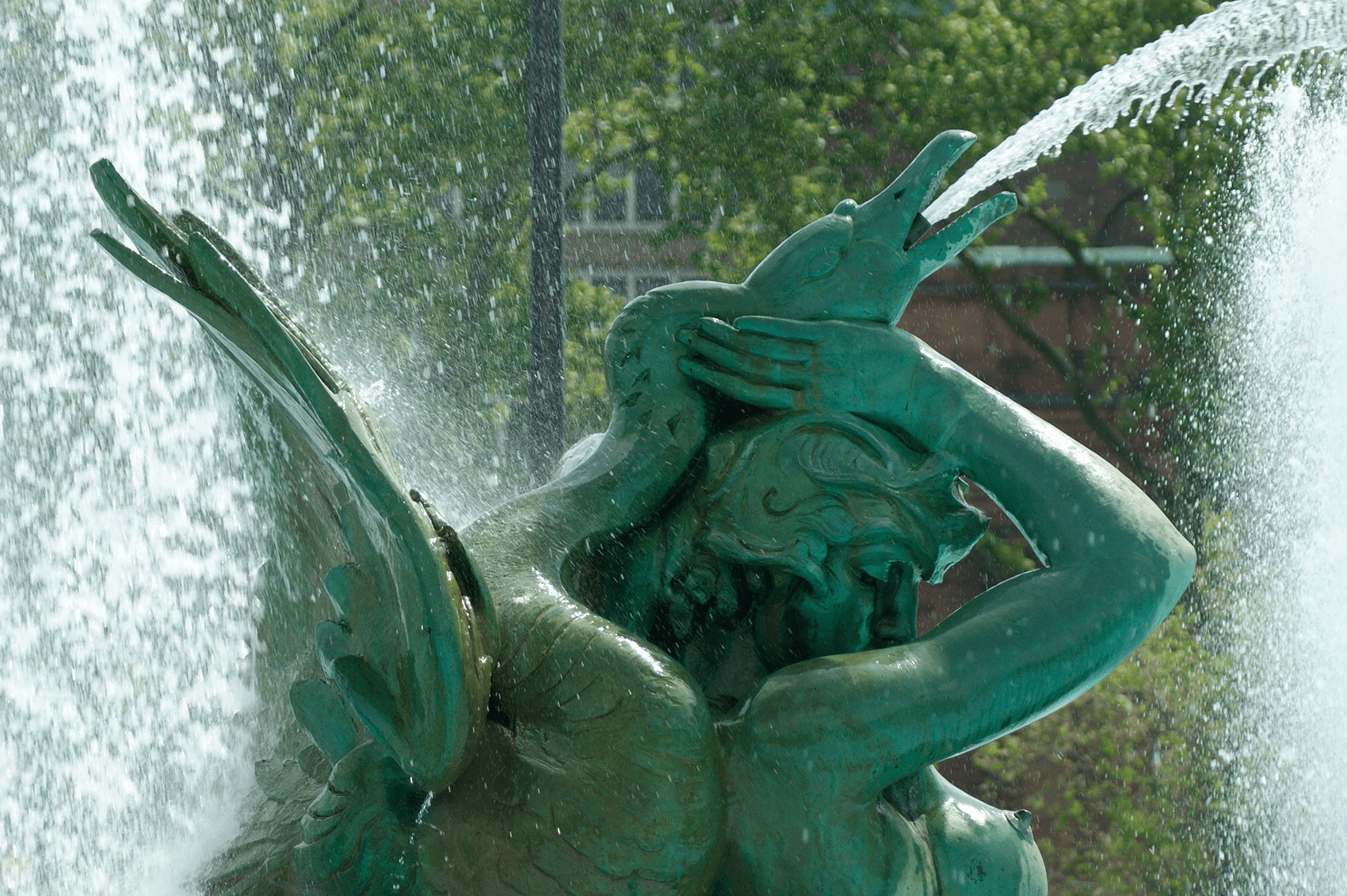
The author of the sculptural composition was Alexander Stirling Calder, a member of a legendary artistic dynasty. His work is a complex allegory of the three main waterways that sustain Philadelphia and its surroundings. Each figure has its meaning and character:
- The Mighty Native American. The central male figure struggling with a swan personifies the majestic Delaware River. His powerful musculature and stern gaze emphasize the strength of the state’s primary navigable artery.
- The Woman with a Swan. It represents the Schuylkill River, which for centuries provided the city with power and water.
- The Girl with a Swan. The most delicate figure, symbolizing the Wissahickon Creek—a picturesque tributary known for its natural beauty.
The use of swans in the composition is a pun on the benefactor’s surname (Swann). The water jets are designed to create a heavy mist effect, which on hot days literally envelops the bronze figures, creating an illusion of movement.
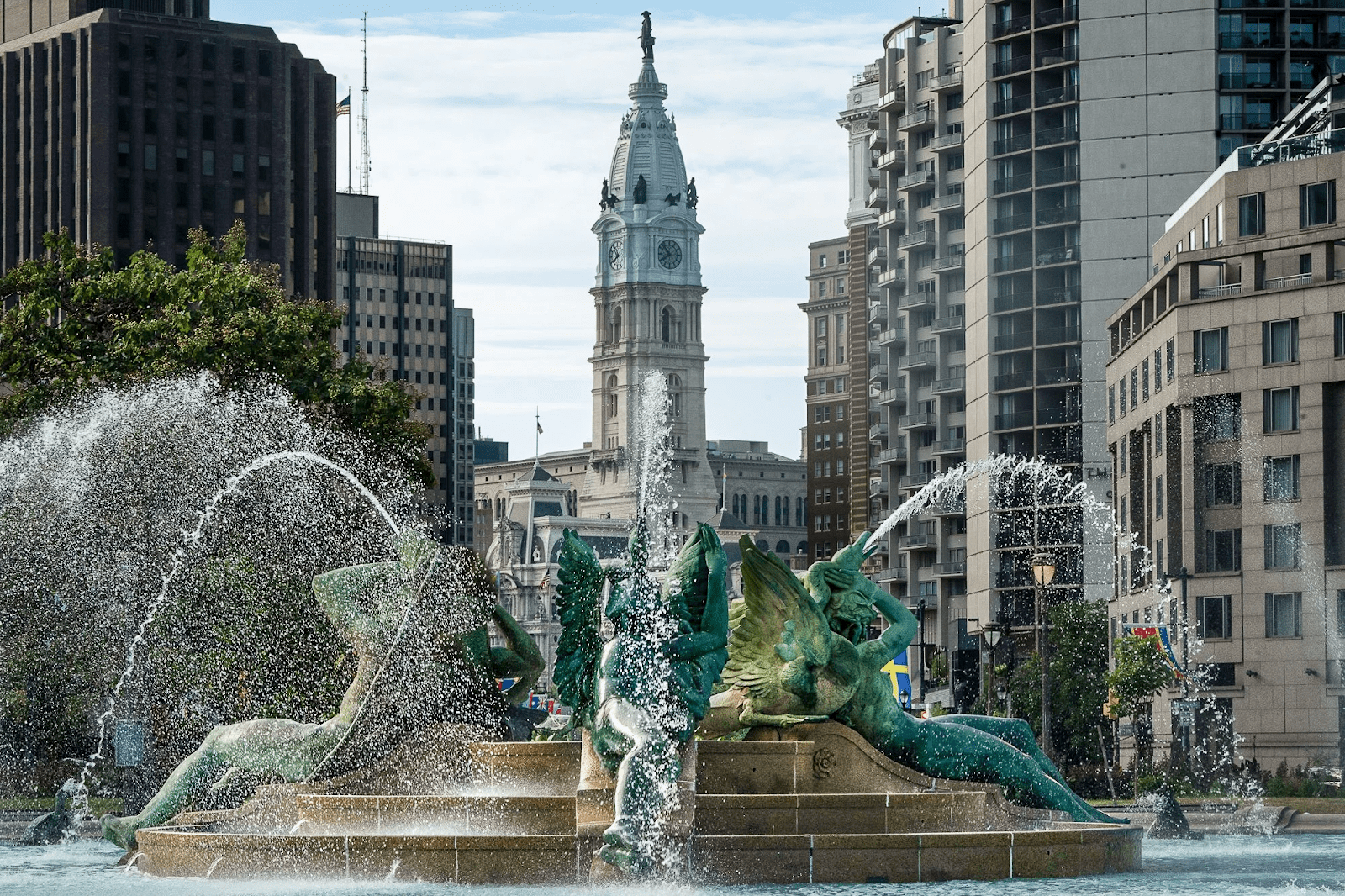
The Calder Dynasty: The City’s Visual Code
The uniqueness of the Swann Fountain also lies in its role within an incredible artistic lineage. Three generations of the Calder family shaped the face of Philadelphia, creating three distinct eras within a single line of sight:
- Alexander Milne Calder (Grandfather). Author of the 250 sculptures on City Hall, including the massive statue of William Penn.
- Alexander Stirling Calder (Father). Creator of the Swann Fountain, embodying classical ideals in the Art Deco style.
- Alexander Calder (Son). The world-renowned creator of “mobiles,” whose enormous kinetic sculpture Ghost adorns the atrium of the nearby Philadelphia Museum of Art.
Standing at the fountain, one can see a perfect perspective: from Stirling Calder’s water allegories, the eye travels directly to City Hall, crowned by his father’s work. This is a unique example of how one family defined the aesthetic landscape of a major metropolis.
A Living Tradition: The Fountain as an Urban Pool
Despite its official status as an architectural landmark and the prohibitions against swimming, the Swann Fountain holds a special social status. For decades, it has served as an unofficial “urban air conditioner.” In the July heat, when temperatures in Philadelphia exceed 95°F (35 °C), the fountain’s basin fills with children and adults seeking relief from the humid swelter.
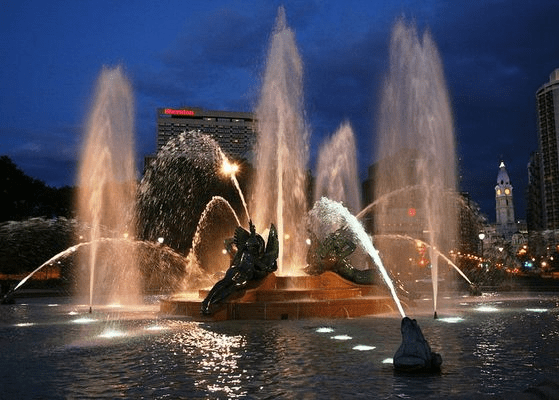
City authorities generally treat this with understanding, as the fountain has become an integral part of the city’s summer culture. In winter, when the water is turned off, the bronze figures freeze in the crisp air, illuminated by holiday lights, reminding us that water is the life that Wilson Swann once sought to provide to every resident.
Key Facts about the Swann Memorial Fountain
| Characteristic | Parameter / Detail | Significance and Context |
| Year of Opening | 1924 | A landmark that celebrated its centenary in 2024. |
| Style | Art Deco / Neoclassical | A blend of geometric rigor and soft bodily plasticity. |
| Sculptor | Alexander Stirling Calder | Son of the City Hall sculptor and father of the kineticism founder. |
| Symbolism of Figures | Delaware, Schuylkill, Wissahickon | Personification of the region’s three main waterways. |
| Dedication | Wilson Cary Swann | Philanthropist focused on the purity of urban water. |
| Location | Logan Circle | The geographical center of the Benjamin Franklin Parkway. |

