
Broad Street Station in Philadelphia was not just a railway station; it was a monumental symbol of power, the economic heart of the city, and an architectural masterpiece of the Victorian era. Built by the Pennsylvania Railroad (PRR), this grandiose terminal operated from 1881 to 1952, surviving the Golden Age of Railways and two World Wars. Its demise due to a fire and subsequent demolition became a painful loss for Philadelphia’s cultural heritage and marked the end of the era of steam dominance in Center City. To this day, architects and historians recall it as an example of lost railroad grandeur. We examine the details of how Broad Street Station was built, how much money was spent, what significance it had for the city, and why it disappeared from the map of Philadelphia on philadelphia-future.
A Victorian Landmark
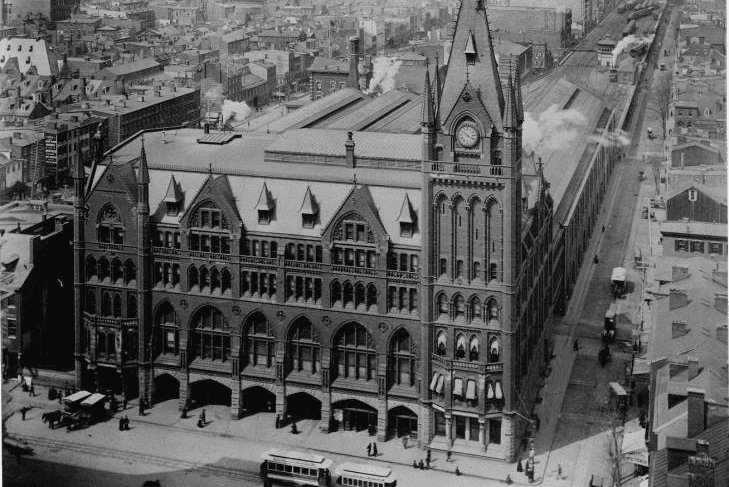
The opening of the railway terminal in 1881 was a landmark event that changed the face of Philadelphia. The building impressed contemporaries with its majesty and the chosen Gothic Revival style, which was the height of architectural fashion in the Victorian era.
The original concept for this ambitious project belonged to the well-known architectural firm Wilson Brothers & Company. However, the building gained its full, expressive individuality after the intervention of another genius. In 1893, the façade was significantly supplemented and modernized according to the design of Frank Furness. Furness, known for his expressive and richly detailed architecture, added elements that made the station a true work of art.
The station stood out distinctly against the urban landscape thanks to its monumental façade, crafted from bright red brick and adorned with rich terracotta. The architectural ensemble was complemented by characteristic Gothic windows and a tall clock tower that served not just to tell time but acted as a visual landmark and a symbol of arrival for residents and visitors throughout the city.
The Chinese Wall
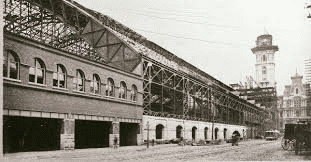
An integral and, arguably, the unique engineering feature inextricably linked to the station’s operation was its approach rail trestle. Among the public, it quickly received the unofficial but apt name “The Chinese Wall.” It was a truly monumental stone and brick structure that stretched for several blocks through the central business district, raising the railway tracks to a height significantly above city street level.
The main goal of creating this massive masonry structure was the radical elimination of grade crossings where railway lines intersected busy city streets. In the late 19th century, such intersections were a constant source of danger, causing numerous accidents and disastrously slowing down train traffic. The “Wall” solved this problem, ensuring crucial safety and continuous speed of movement.
Structurally, the trestle was a complex architectural and engineering system that included a series of powerful viaducts, specially designed bridges, and the two-level platforms of the station itself. Its colossal volume and quality of execution attested to the advanced engineering capabilities and financial might of the Pennsylvania Railroad (PRR).
Although the successful operation of this structure was a triumph of logistics, its presence led to significant social and urban consequences. The “Chinese Wall” created a physical, insurmountable barrier that sharply divided the city’s business districts. It complicated urban planning, restricted traffic flow, and created shadows and noise zones at street level. Because of this, it was long a subject of frequent disputes and criticism among residents, who saw it as a symbol of the domination of corporate railroad interests over community needs. This massive structure served as a vivid example of the contradiction between the need for fast transport links and the integrity of the urban space.
Tragic Finale: Fire and Forgetting
The Central Station ceased operations in 1952. Its functions were entirely transferred to the newer and significantly more modern transportation hub—30th Street Station. The Pennsylvania Railroad (PRR) planned the demolition of the building and the “Chinese Wall” to free up this large land area for an ambitious project of central city development. Economic expediency demanded replacing the Victorian structure with something more modern and functional.
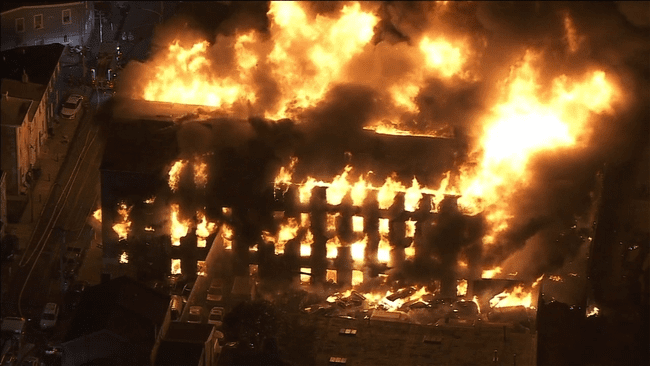
However, the finale of the Victorian masterpiece turned out to be accelerated and extremely dramatic. In September 1953, a major fire broke out in the already abandoned building. The fire quickly engulfed and destroyed a significant portion of the historic structure, leaving only scorched ruins of the magnificent façade. This disaster, likely caused by arson or negligence, hastened the final decision to demolish. Instead of prolonged planning, the city authorities received a compelling argument for immediate dismantling.
The loss of Broad Street Station was irreparable from the perspective of architectural heritage. The monumental Gothic Revival halls and the iconic clock tower were swept away. In their place, Penn Center was built—a large complex of office buildings that conformed to the Modernist trends of the 1950s–1960s. This act of destroying a significant historical landmark became a striking symbol of how post-war progress, focused on economic efficiency and new architectural styles, often ruthlessly sacrificed the past for the development of the future.
A Place of Memory
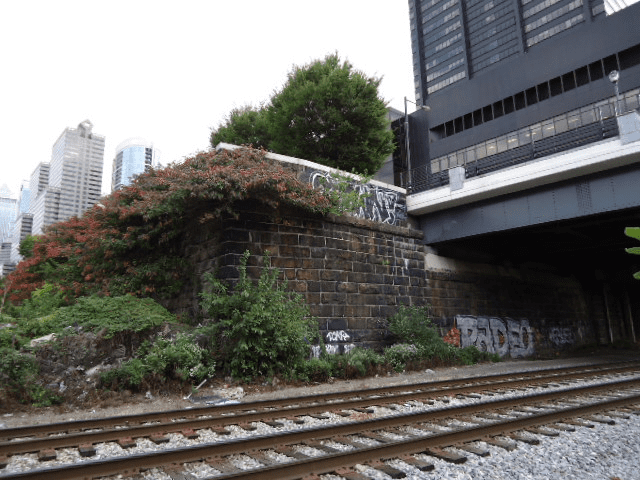
Despite its physical disappearance, the legacy of Broad Street Station remains visible to this day. The area where the “Chinese Wall” once stood is now occupied by the SEPTA Regional Rail transportation network, which uses underground tunnels to pass through Center City, tunnels that were part of this massive project.
Some architectural elements of the station were successfully preserved:
- The Clock. One of the large clocks from the tower was restored and is now an exhibit at the Railroad Museum of Pennsylvania.
- Sculptures. Parts of the decorative stones and sculptures were salvaged and integrated into the landscape design of the new Penn Center buildings, serving as a hint of the former grandeur.
- Photographs and Plans. Thanks to numerous archival records and blueprints, historians can study the construction and design of this lost masterpiece in detail.
This event became a lesson for Philadelphia, pushing the city toward a more careful attitude towards the preservation of historical objects in the future.
Key Data on Broad Street Station
| Characteristic | Parameter / Detail | Significance and Fate |
| Years of Operation | 1881 – 1952 | Symbol of the dominance of the Pennsylvania Railroad (PRR). |
| Architects | Wilson Bros. & Frank Furness | Gothic Revival style, Victorian architectural landmark. |
| Engineering Feature | “The Chinese Wall” | Multi-level trestle that separated the railroad from the city. |
| Reason for Closure | Traffic transferred to 30th Street Station | Modernization of the transport network, need for central development. |
| Tragic End | Fire in September 1953 | Accelerated demolition and irreparable loss of heritage. |
| Current Site Status | Penn Center (office complex) | Area rebuilt for modern business needs. |
Sources:
- https://philadelphiaencyclopedia.org/essays/railroad-stations/
- https://whyy.org/articles/from-above-frank-furness-broad-street-station-1920/
- https://www.theconstitutional.com/blog/2018/09/03/30th-street-station-and-porch-30th-street
- https://www.phillyvoice.com/then-and-now-broad-street-station-fire-frank-furness/

