

Moyamensing Prison, located south of Philadelphia, was designed by architect Thomas Walter. Construction began in 1832, and the official opening took place on October 19, 1835. Despite being built with the intention of lasting for centuries, the facility was demolished in 1968. Since then, it remains only in the annals of history and Philadelphia’s architectural records. Read more at philadelphia-future.
Moyamensing Prison: A Brief Overview
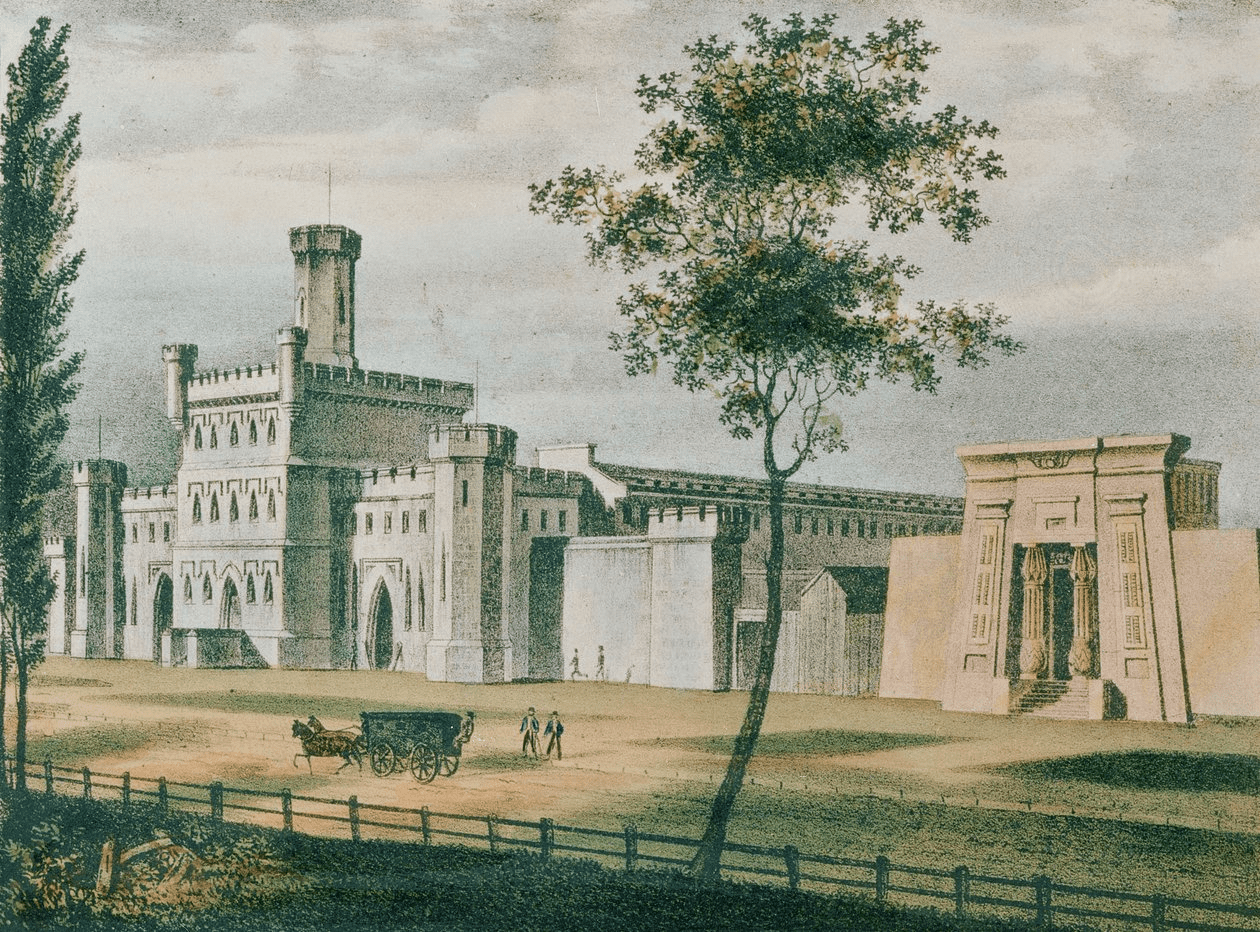
In 1831, the General Assembly of the Commonwealth of Pennsylvania authorized the construction of a prison for the City and County of Philadelphia. It was planned for the town of Moyamensing, situated about a mile south of the city’s boundary. However, from its very beginning, the prison was considered a Philadelphia institution, and later the city absorbed this suburb, making its intended affiliation a reality.
Officials allocated 16 acres of land for the prison, but the constructed facilities occupied much less space. The prison consisted of three buildings. Construction of the main one lasted from 1832 to 1835. Within a year of its opening, an annex known as the “debtors’ wing” was built on the northern side. This later became a women’s prison. Another building, on the western side of the prison, was completed in 1838.
The Architecture of Moyamensing Prison
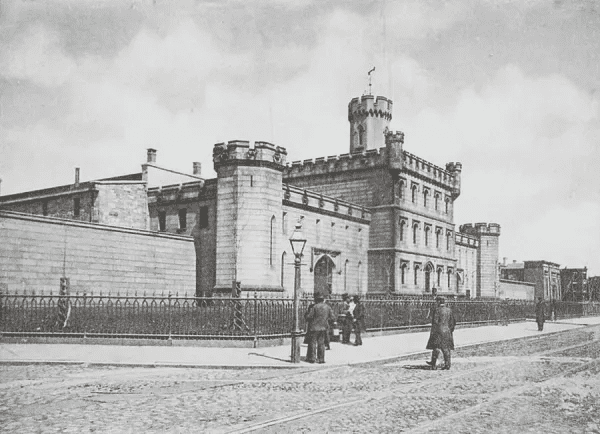
All three sections of Moyamensing Prison were designed by Philadelphia architect Thomas Walter. He chose a style reminiscent of medieval castles, using English Gothic for the buildings’ ornamentation. In 1870, he also drafted plans for the facility’s expansion, but those remained on paper.
The central building had a width of 53 feet with two wings, each 50 feet long. Around them, octagonal towers were built, transitioning into walls and culminating in bastions. The exterior was finished with blue syenite, brought to Philadelphia from Massachusetts.
The central building was designed with three stories. Each subsequent floor was smaller than the previous one and adorned with a projecting band. At the corners, there were circular watchtowers, 5 feet 4 inches in diameter. They protruded slightly above the building and were equipped with battlements. The front wall also featured battlements and embrasures. An octagonal tower, 77 feet tall, rose above the central building. The building’s wings were two-story and had separate entrances. They were equipped with sliding windows and parapets with loopholes.
Inside Moyamensing Prison
Inside, the prison had sections for male defendants, for convicted men, and for women.
The main building featured 408 individual cells, situated along its entire perimeter from the wings to the main facade. These cells opened into 20-foot-wide corridors that also stretched the entire length of the building. At the beginning of the corridors was a clerk’s office, offering a clear view of all cell doors. Granite stairs led to the second and third floors.
Each cell was 9 feet wide, 13 feet long, and 9 feet high. Amenities included a sink, a toilet, and flues for ventilation, fresh air intake, and warm air from furnaces in the building’s basement. The furnaces were centrally located and at the end of each block. Warm air from them was distributed through spaces beneath the corridors. The building also had chimneys extending from the furnaces to the roof. Overall, the designed heating system allowed for maintaining optimal temperatures in the cells during cold weather.
The outer walls of the cells were wooden, lined with iron on the inside. The doors were held by cast-iron frames and sashes, which were built into the full thickness of the prison walls.
A separate women’s facility measured 150 by 340 feet. It could be accessed through a gate from the main prison yard. The building was two-story and contained 100 individual cells, each 8 by 12 feet. The cell amenities were the same as those for men. This building also housed an infirmary and guard rooms.
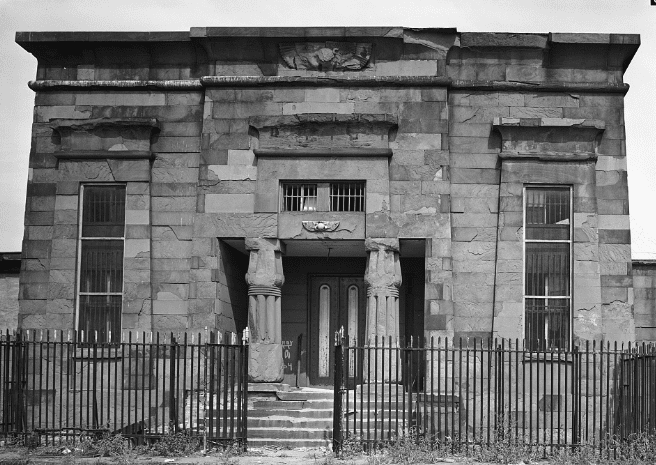
The “debtors’ wing” was located north of the main prison building and east of the women’s section. It had two floors and a basement, measuring 50 feet by 86 feet. The exterior facade was made of brown sandstone in the Egyptian style. The facade featured a portico and two columns. The windows were adorned with cornices, and overall, the building looked quite ornate and bore little resemblance to a prison.
Finally, Moyamensing also had a separate building that housed the kitchen, bakery, laundry, and bathhouse. Its area was 43 by 72 feet. It was situated between two cell blocks in the courtyard. This area could also be accessed from all parts of the prison via covered walkways. The kitchen had steam boilers and four cast-iron tanks, each holding 80 gallons. Here, prisoners’ clothes were boiled to prevent the spread of diseases.
Five Facts About Moyamensing Prison
This prison complex was meticulously planned, as it was intended for use over centuries. However, its use ceased in 1963, and most of the buildings were demolished five years later. The front portico of the “debtors’ wing” was transferred to the Smithsonian Institution as an architectural artifact.
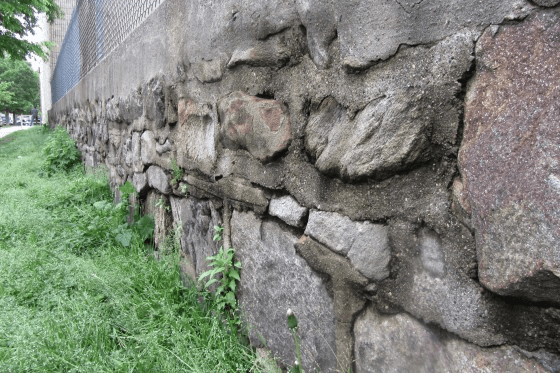
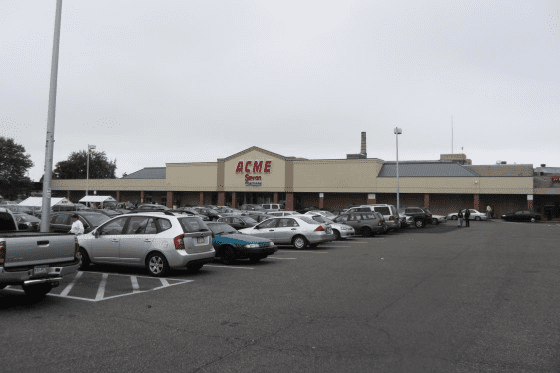
In the 21st century, only a low stone wall remains on the parcel along Reed Street, next to the “Acme Market” shopping center. These remnants of Moyamensing Prison were included in the Philadelphia Register of Historic Places in 2019. Thus, this complex now lives only on the pages of history.
Here are some interesting facts about Moyamensing Prison worth noting:
- Architect Thomas Walter, who created the design for this prison complex, also designed the U.S. Capitol. He is credited with conceiving the Capitol’s distinctive wings and dome, which created its widely recognized modern appearance. Moyamensing marked the beginning of his architectural career, where he first combined Gothic and Egyptian styles in one building.
- H.H. Holmes, America’s first known serial killer, was executed by hanging right here. Herman Webster Mudgett (the criminal’s real name) was a con artist and fraudster. He committed his infamous murders during the 1893 World’s Columbian Exposition in Chicago, luring victims to his large house, which he disguised as a hotel. His execution at Moyamensing took place in 1896.
- This prison hosted the last execution by hanging in Pennsylvania. This occurred in 1916. As early as 1834, the state was the first to abolish public hangings. After this, each county conducted executions only within prisons, and later, hanging was replaced by execution by electric chair.
- Edgar Allan Poe once stayed at this prison. The famous writer was sleeping on the street one night in 1849 after alcohol abuse. Police arrested him for public intoxication and took him to Moyamensing. Poe spent the night in prison and was released the next day.
- Al Capone also spent one night in this prison. On May 16, 1929, the notorious gangster and his bodyguard Frank Kline were arrested in Philadelphia by detectives James Malone and Jack Creedon. They were transferred from prison to prison, including Moyamensing. Al Capone was later moved to Eastern State Penitentiary, and a few months after these events, he was released.
So, Moyamensing Prison certainly saw a lot throughout its history. This complex fulfilled its historical role, operating for over a hundred years.