

“Monopoly,” the world’s most popular board game, is over 100 years old, with more than a billion people having played it. In the late 90s, the most expensive version of the game, a jewel-encrusted set, was created, valued at $2,000,000. Traditional Monopoly tournaments are held worldwide, and the longest game ever recorded lasted approximately 70 days! People have played Monopoly on ceilings, underground, and even inside a U.S. nuclear submarine. The Beatles even played it during their first tour of the country. During World War II, this game was used to smuggle contraband—escape maps, compasses, and real money instead of game money—into prisoner-of-war camps in Germany! The game is so popular that a documentary about it even won an Emmy Award. But not everyone knows that Monopoly is special for another reason: it was invented not once, but twice. Learn more at philadelphia-future.
Lucky Charles
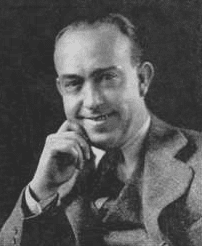
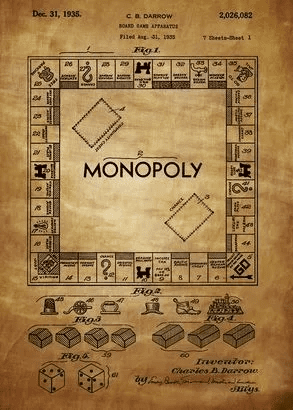
Charles Darrow was born in Philadelphia, Pennsylvania, in 1889. Who knows if he would have become famous if he hadn’t registered the board game “Monopoly” on July 30, 1933, a game that would later achieve massive global popularity. Paradoxically, the Great Depression actually helped spur the game’s invention. During that period, Charles’s business, which involved selling, installing, and repairing heating boilers and had previously brought him a decent income, completely collapsed. Desperate, he spent his days looking for ways to earn money for his family. One evening, after another fruitless day of searching for work, Charles sat in his kitchen, lamenting his past prosperous life and feeling dejected by the nostalgia. Amidst memories of his former happy life, he recalled a trip to Atlantic City, where he and his wife had visited various casinos. Unconsciously, he began drawing the city’s streets on the tablecloth. Soon, he was crafting all sorts of buildings—cafes, gaming establishments, hotels, restaurants—from whatever objects he could find.
His wife entered the room and saw the ruined tablecloth. To avoid getting into trouble, the ingenious Charles decided to draw her into his “city” and the life within it. He drew the money they both so desired. In a flash, the couple was competing to acquire various properties.
And so, Atlantic City on a kitchen tablecloth transformed into an exciting game. Each participant, poor or rich, could easily become a successful businessman. Soon, several of his games Charles distributed to acquaintances. Manufacturing the game incurred certain costs, so Charles had to charge a few dollars per set.
During this period, a robust working class was emerging in the U.S., and board games became incredibly popular. Comforts at home, particularly the availability of electricity, allowed people to enjoy leisure activities in the evenings. And when the workday was shortened to 8 hours, even the working class gained additional free time.
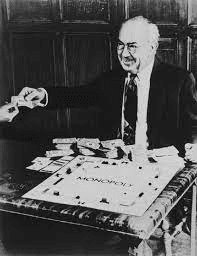
Given the positive feedback on his game, the enterprising Charles decided to send a sample to the large company Parker Brothers. However, their leadership dismissed the game as having no prospects. The company found more than 50 fundamental flaws in the game, including issues with its length, complexity, and theme. But the indefatigable Darrow didn’t give up. In 1934, he asked a printer to produce five hundred sets of the game board for him. Charles then sent them to department stores in Philadelphia. The game’s distribution was a resounding success! Users absolutely loved it! After that, Parker Brothers sought to collaborate with Charles Darrow. Following renewed negotiations, the company acquired the rights to the game. As he had dreamed, Charles became a wealthy man. In 1935, his game was released under Parker Brothers’ ownership. Initially, it conquered the U.S., and then it set out to conquer the world! And “Monopoly” not only succeeded but even influenced the development of computer games.
Elizabeth, Who Wasn’t So Lucky
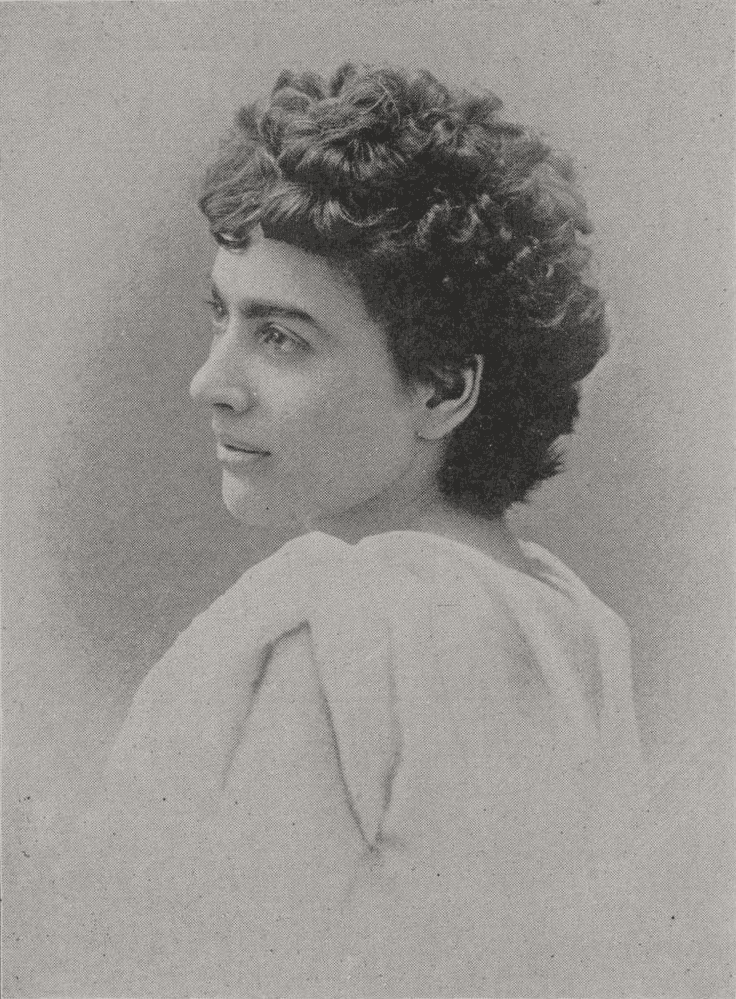
However, this lucky story would be too perfect if it didn’t turn out that Monopoly, besides its inventing father, also had an inventing mother. She was Elizabeth Magie from Macomb, Illinois, an activist who, during a difficult period for the country, wanted to expose the problems of capitalism. She advocated for equality among different classes. Her father was an anti-monopolist and supported the ideas of Henry George, who believed that people should own what they create. According to his theory, land and the right to use it should belong to everyone, just like air. At 40, Magie was proud that she was still unmarried, and thus independent. She worked, accumulating enough funds for her own support, and spent a lot of time on her brainchild—a game based on Henry George’s theories. In 1904, Magie received a patent for the board game “The Landlord’s Game.” This news appeared in the press, and that year, the percentage of women who also patented their inventions in the country increased.
The concept of her “Landlord’s Game” involved in-game businesses that were bought and sold for money. Players could borrow money from the bank or from each other and paid taxes if they landed on a property owned by someone else. This game broke from the typical linear principle of the time; movement across the board was quite multidirectional, and the rules were engaging.
To highlight the advantages of leftist ideas and emphasize the flaws of capitalism, she devised two versions of the game: “Monopolist” and “Prosperity”. In the second, anti-monopoly version, everyone received a reward when wealth was created. The goal of the monopoly version was to create monopolies and crush opponents. The first version, where the player’s goal was to buy as much real estate as possible and win by bankrupting others, was designed by the author to demonstrate a model of land seizure by one person and “loss” for the rest. However, “Prosperity,” where players did not pay taxes for visiting other people’s real estate, could build freely, without the threat of going to jail, and so on (according to Henry George’s theory), ended with a win for everyone. Magie’s invented game was like a small model of real human life, where one could observe success, failures, the pursuit of wealth, and such. Students and university professors who used the game to demonstrate various financial concepts greatly contributed to its popularization. Over time, players not only enjoyed the game but also began to make their own adjustments, for example, regarding their local area or the laws of a particular state. And one of these “editors,” in essence, turned out to be Charles Darrow, who was looking for salvation from his own poverty.
Some claim that Charles Darrow and his wife, Esther, first had the chance to play “The Landlord’s Game” in 1932 during a visit to businessman Mr. Todd in Philadelphia, rather than somewhere else. This is because Todd supposedly later recalled that the couple had not seen such an interesting pastime before that instance and showed great interest in it. So much so that they even asked their host to write down the game’s rules. Perhaps later, in his search for a way out of poverty, Charles Darrow remembered this game, which became his salvation?
The Professor Who Revealed Monopoly’s Secret Origin to the World
After changing the game’s rules, Charles Darrow presented it as his own invention, registered the rights, and gave it a new name—“Monopoly.” And then his story continued, as described above. When Darrow’s game was released to the public, in the first year alone more than 2 million copies were sold. In 1934, “Monopoly” became the most popular Christmas present. Darrow sold the game to the company on very favorable terms and subsequently received regular payments. Learning about Elizabeth Magie’s patent for her game and assuming that her truth might come to light, Parker Brothers bought the rights to the invention from her for about $500 without her right to receive royalties if the game was successful. Subsequently, the company also acquired patents for all of Magie’s game variants, thus fully owning them. The company also changed the game’s rules: getting rich and bankrupting others became the main goal.
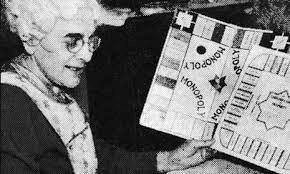
The author’s subsequent claims were unsuccessful. Eventually, Parker Brothers officially stated that the games “Monopoly” and “The Landlord’s Game” were unrelated. To minimize any risks, the company also purchased two other games from Magie.
The world learned about the inventor of “Monopolist,” Elizabeth Magie, by chance. In 1973, economics professor R. Anspach began a decade-long legal battle with Parker Brothers for his anti-monopoly game. During the investigation, Magie’s patents also surfaced.
The inventor died in 1948, never seeing justice in court. Darrow died in 1967, retaining his status as an inventor and a rich man who rose from humble beginnings. In 1991, another company acquired Parker Brothers, and thus the rights to “Monopoly.”