

The history of women in programming traces back to the 19th century with British mathematician Augusta Ada Lovelace, who is credited with pioneering the field. One of her most notable successors, and a true icon in the world of computing, was American IT pioneer Frances Elizabeth Holberton. She was among the first computer programmers, the lead programmer for the world’s first electronic computer, ENIAC, and the brilliant mind behind the data sorting program. Learn more on philadelphia-future.
A Mathematical Mind from Childhood
Frances Elizabeth Holberton (née Snyder) was born in Philadelphia, Pennsylvania, in 1917. From a young age, Betty, as she was known, displayed a natural aptitude for mathematics. After high school, she enrolled at the University of Pennsylvania with the intention of studying math. However, during her first advanced math class, a professor infamously suggested she’d be better off at home raising children. This dismissive comment gave Betty pause, but rather than deterring her, it prompted a shift in her educational path. While she continued her studies, she pivoted to journalism, though she never truly abandoned her love for mathematics. She reasoned that a journalism degree would involve frequent travel and expose her to diverse topics. Moreover, in the 1940s, journalism was one of the few professions that offered women a path to self-fulfillment and career advancement.
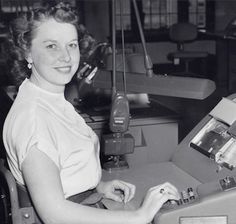
Joining a Groundbreaking Team of Pioneer Programmers
After graduating, Elizabeth was invited to train and work at the Moore School of Electrical Engineering. The institution was actively seeking women with strong mathematical skills, selecting the best among them for a government project: the creation of the first general-purpose electronic digital computer, ENIAC. The decision to involve women in a field previously dominated by men stemmed from a shortage of male personnel during World War II. The military urgently needed female specialists to calculate ballistic trajectories. Soon, Betty Holberton became one of six women entrusted with programming ENIAC and emerged as a leader within this pioneering team. Her colleagues included Kay McNulty, Marlyn Wescoff, Ruth Teitelbaum, Betty Jean Jennings, and Fran Bilas. This dedicated team of women worked tirelessly with blueprints and electrical schematics to program ENIAC.
Through their hard work, these female computer pioneers successfully programmed ENIAC for military purposes, specifically to calculate the trajectories of ballistic missiles and other weaponry electronically for the U.S. Army’s Ballistic Research Laboratory.
Elizabeth Holberton not only mastered the programming but also initiated several proposals for its improvement. Colleagues often recalled Elizabeth’s unconventional logic and how she generated optimal ideas for ENIAC’s complex calculations. Most of her solutions, they said, came to her in her dreams.
For understandable reasons, the details and results of ENIAC’s operations remained classified for a long time. It’s even rumored that not everything is known about it to this day.
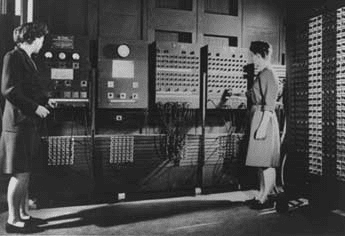
On February 15, 1946, ENIAC was publicly unveiled at the University of Pennsylvania. At the time, its cost was $487,000. During the presentation, it all looked deceptively simple. After an engineer pressed a button, the computer would calculate a shell’s trajectory in seconds. In reality, setting up the machine for tasks required the women to manually toggle switches, route cables, and, before that, solve differential equations to determine the correct configuration. The machine weighed up to 30 tons and contained 17,000 vacuum tubes, 70,000 resistors, 10,000 capacitors, and thousands of manual switches and relays. Consequently, the women programmers spent not just days, but weeks, programming and debugging the device. This was because no programming languages existed at that time.
After the ENIAC presentation, the female working group disbanded. However, Elizabeth had no intention of ceasing her work in programming.
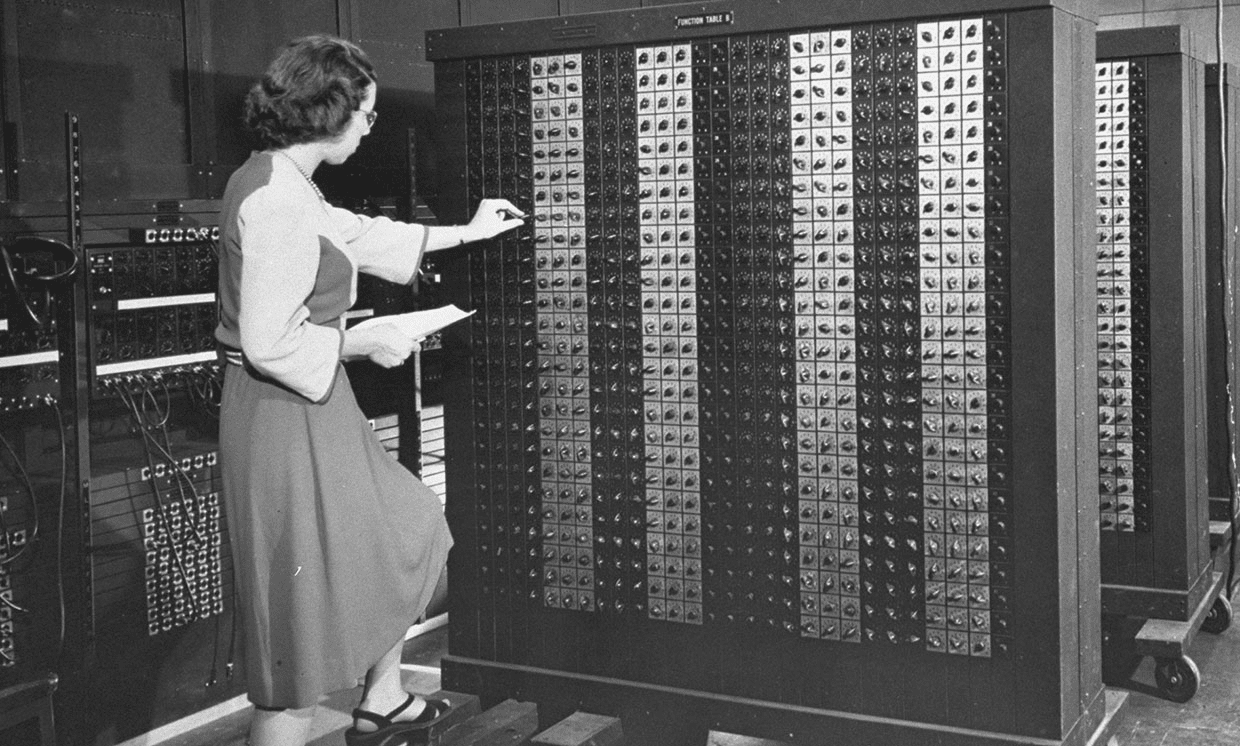
Betty Holberton working on ENIAC
New Successes in Peacetime
After World War II, Holberton worked at Remington Rand and the National Bureau of Standards. From 1959, she headed the programming research section at the David Taylor Model Basin’s Applied Mathematics Laboratory. There, she reunited with some of her ENIAC developers to create another computer: the commercial UNIVAC. Elizabeth Holberton played a key role in developing the control panels for UNIVAC, including placing the numerical keypad next to the keyboard. She also persuaded engineers to change the UNIVAC’s casing color from black to the now-universal gray-beige and influenced the keyboard’s layout. She was among the first to write a rapid programming system (sort/merge). Holberton used a deck of playing cards to develop a decision tree for a binary sorting function and wrote code that utilized ten tape drives for reading and writing data during operation. Elizabeth designed a program for sorting and merging large datasets, which were then stored on reels of magnetic tape. At the time, updating data was a tedious process, but Betty’s invention simplified and sped it up. She also created the first statistical analysis package, used in the 1950 U.S. Census.
In 1953, Holberton joined the U.S. Naval Applied Mathematics Laboratory in Maryland, where she became the chief of advanced programming in the Applied Mathematics Laboratory’s division. She collaborated with J. Mauchly and I. Rhodes on developing an instruction set for UNIVAC I, considered a prototype for all modern programming languages. As a leading specialist at the lab, Holberton contributed to developing standards and specifications for the business programming language COBOL, as well as FORTRAN. More than 60 years after its release, COBOL is still actively used in corporate circles. Later, as a representative of the National Bureau of Standards, she actively participated in developing the first two editions of the FORTRAN-77 and FORTRAN-90 language standards.
Well-Deserved Recognition
In 1997, Elizabeth Holberton became the only one of the original six women who programmed ENIAC to receive the Augusta Ada Lovelace Award, the highest honor from the Association for Women in Computing. That same year, she was awarded the “Computer Pioneer Award” by the IEEE Computer Society for her development of the sort-merge generator. Also in 1997, Elizabeth Holberton was inducted into the Women in Technology International Hall of Fame alongside her fellow original ENIAC programmers. Since 2016, the Holberton School—a network of educational institutions named after the distinguished American—has operated on five continents. These inclusive institutions live by the motto: everyone can master IT.
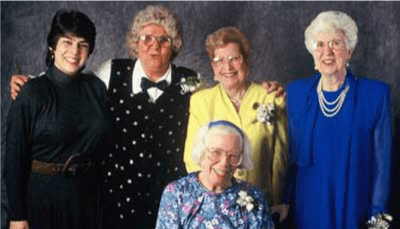
The celebrated programmer passed away on December 8, 2001, at the age of 84. Elizabeth Holberton felt that she had fully realized her potential in her profession. She once remarked that she had lived a fantastic life because everything she did was the beginning of something new.